


Augustines City Of God - A Readers Guide
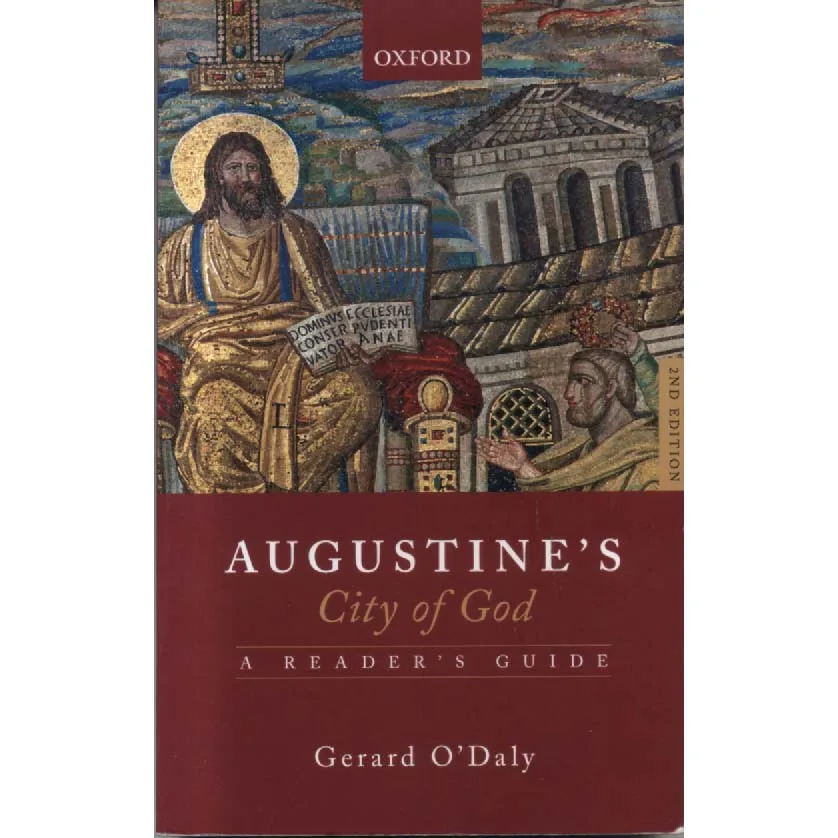
Publisher: Oxford University Press
Format: Paperback
ISBN: 9780198841241
Some books ask gentle questions. Some confidently provide answers. And then there is Augustine’s City of God, a work that spends over a thousand pages contemplating civilisation, politics, history, morality, eternity, the collapse of empires and humanity’s ultimate destiny, while quietly reminding the reader that the fall of Rome was perhaps not quite the end of the world after all. Naturally, this means that most sensible people appreciate a guide before venturing in.
Enter Gerard O’Daly’s Augustine’s City of God – A Reader’s Guide, published by Oxford University Press in 2020. Rather than attempting to simplify Augustine into a handful of comforting slogans, O’Daly performs the considerably more useful service of acting as an informed travelling companion through one of the most influential—and occasionally intimidating—works ever written. Think of him less as someone carrying your intellectual luggage and more as the experienced mountaineer pointing out where previous travellers have accidentally wandered off philosophical cliffs.
Saint Augustine’s City of God has shaped Western thought for over sixteen centuries. It has influenced theologians, philosophers, historians, political thinkers and countless university students who suddenly discovered that reading late Roman theology at two o’clock in the morning requires rather more coffee than originally anticipated. O’Daly gently unpacks Augustine’s arguments, placing them within their historical context while showing why this monumental work continues to matter in discussions about religion, politics, justice and the nature of society itself.
The title is wonderfully reassuring. A Reader’s Guide carries with it the comforting implication that someone has already negotiated the more labyrinthine passages on your behalf and left useful signposts behind. There is no shame whatsoever in accepting such assistance. After all, if you were setting off across medieval Europe you would probably appreciate a map. Traversing Augustine’s thought is remarkably similar, except the hazards involve intricate theology rather than wolves.
One of the great pleasures of this book is that it reminds us how startlingly modern many of Augustine’s concerns remain. He wrote while witnessing political upheaval, cultural anxiety and endless arguments about where society was heading—all subjects that have, rather inconveniently, never gone out of fashion. The result is a guide that illuminates not only an ancient masterpiece but also why people continue returning to it whenever civilisation appears to be having one of its periodic existential crises.
Published by Oxford University Press, this is scholarship at its most approachable: rigorous without being forbidding, intelligent without showing off, and written with the quiet confidence of someone who knows that explaining difficult ideas clearly is considerably harder than making them sound impossibly complicated. Whether you’re approaching City of God for academic study, personal interest or simply because you enjoy books capable of making your brain work overtime, O’Daly provides an excellent companion.
This copy is in good condition, showing the gentle signs of having been read rather than merely displayed in the optimistic hope that philosophical wisdom might somehow transfer itself through proximity alone. The binding remains sound, the pages are clean, and it is perfectly prepared to guide its next reader through one of the towering monuments of Christian thought.
As always, Crappy Old Books delights in rescuing books that reward curiosity rather than haste. Augustine’s City of God – A Reader’s Guide won’t instantly solve every theological puzzle or settle two thousand years of philosophical debate, but it will ensure that when someone casually mentions Augustine over dinner, you’ll have considerably more to contribute than a vague recollection that he had rather a lot to say about Rome. And that, in itself, feels like progress.
Keep browsing: See more Religion books Other books by Gerard ODaly
